

Is Ford Really Reliable in 2026? Let’s Separate Myth from Reality
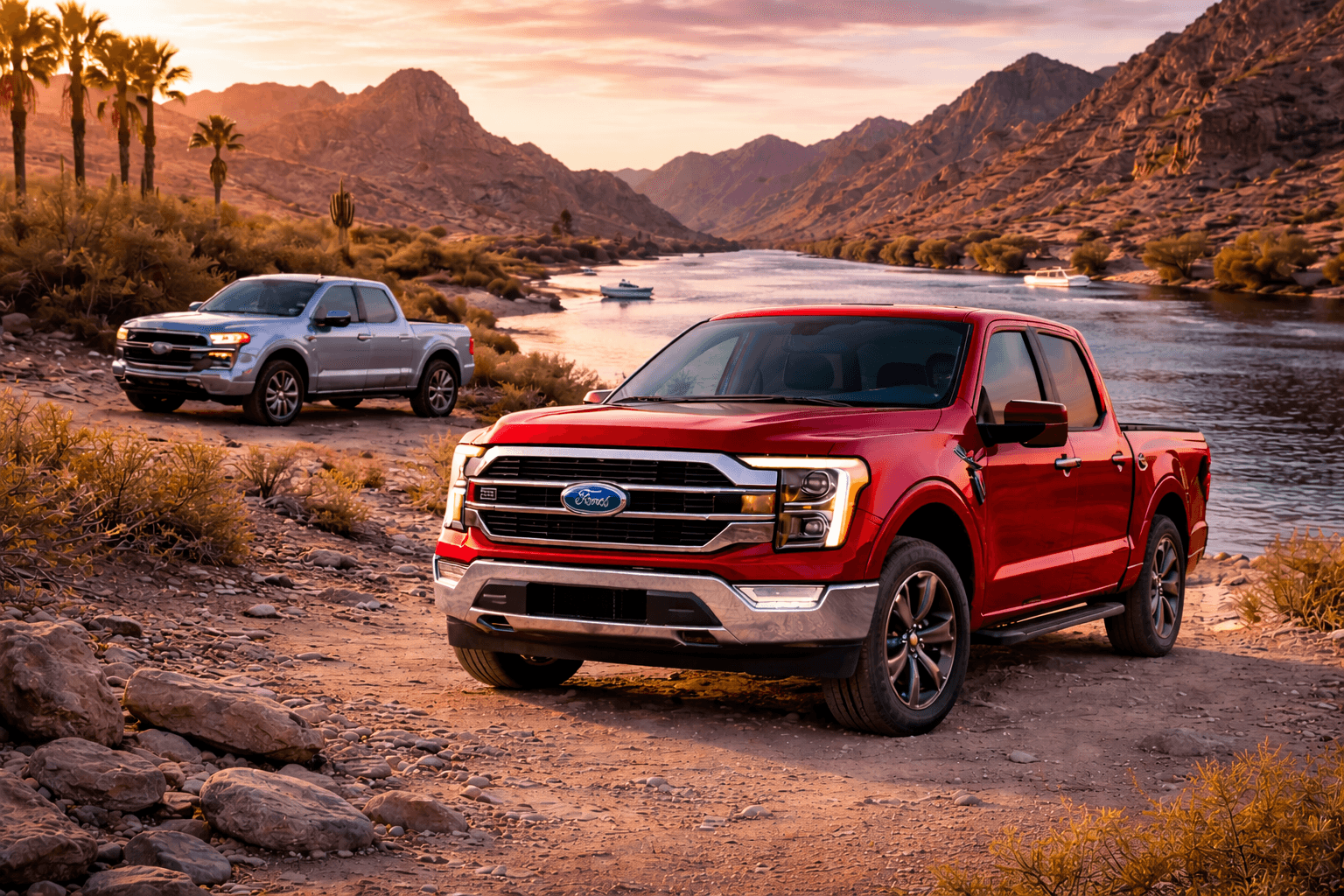
Are Ford trucks reliable in 2026?
It sounds like a simple question, but the useful answer requires more than repeating an old reputation—good or bad.
Truck reliability depends on several different things:
- How the vehicle was engineered and tested
- Initial build quality
- The specific engine and configuration
- How much towing, hauling, idling, or off-road use it sees
- Maintenance history
- Climate and operating conditions
- How the truck is treated over years of ownership
For drivers throughout Western Arizona, those last few points matter more than they might in an easier operating environment.
Heat, long highway distances, towing, steep grades, dust, recreational trailers, construction work, and property use can all place additional demands on a truck.
So rather than saying “Ford is reliable because Ford says so,” this Anderson Auto guide looks at what we can actually verify about the 2026 Ford F-150, how Ford tests its trucks, what independent quality data says, and what owners can do to protect a truck over the long term.
First: Reliability and Initial Quality Are Not the Same Thing
This is one of the most important distinctions when researching any new vehicle.
Initial quality tells us how many problems owners report early in ownership.
Long-term reliability asks a much broader question: how well does a vehicle hold up after years of mileage, heat cycles, towing, maintenance, road conditions, and normal wear?
A newly redesigned truck can perform extremely well in an initial-quality study without anyone yet having 150,000 miles on that exact model year.
Likewise, an older model’s repair history cannot perfectly predict how every new truck will perform.
The most responsible way to evaluate a 2026 truck is therefore to look at several kinds of evidence rather than trying to reduce everything to one score.
2026 Ford Quality Results Are Strong
One useful independent data point comes from the 2026 J.D. Power U.S. Initial Quality Study.
Ford ranked highest among mass-market brands in the study.
Three Ford vehicles also ranked highest in their respective segments:
- Ford F-150
- Ford Super Duty
- Ford Mustang
For the F-150 specifically, that means Ford’s light-duty truck performed very well in owner-reported problems and dealer repair data during the early ownership period measured by the study.
There is an important limitation:
J.D. Power Initial Quality Study results cover roughly the first 90 days of ownership.
That is useful evidence about current production quality. It is not a guarantee of what an individual F-150 will cost to own 10 years from now.
Ford Tests Trucks Far Beyond Normal Daily Driving
Another part of the reliability picture happens before the truck ever reaches a dealership.
Ford says its truck durability programs are designed to compress the equivalent wear of approximately 10 years or 150,000 miles of severe customer use into about four months of testing.
At Ford’s Michigan Proving Grounds, development trucks are subjected to:
- Potholes
- Rumble strips
- Severe vibration
- Rock-crawl-style surfaces
- Water pits
- Steep, heavily disturbed grades
- Testing at gross vehicle weight
- Testing with heavy front or rear loads
- Extended around-the-clock operation
Ford uses both human drivers and robotic test systems so engineers can combine repeatable testing with the variation of real-world driving.
Data loggers monitor components throughout the truck, and Ford says issues discovered during testing are analyzed so engineering changes can be made before customer use.
Durability validation also continues as production begins.
This does not mean Ford guarantees an F-150 will travel 150,000 miles without a repair.
It means the truck is subjected to accelerated durability testing intended to expose weaknesses before customers do.
Ford Tests Vehicles in Arizona Heat, Too
This is particularly relevant for an Anderson Auto article because Ford conducts extreme-heat development work at its Arizona Proving Ground.
Ford engineers report testing when temperatures climb beyond 110 degrees Fahrenheit.
The goal is not simply to see whether the air conditioner feels cold.
Engineers use the desert environment to evaluate vehicle systems under combinations of:
- Extreme ambient heat
- Vehicle load
- Towing load
- Heat soak
- Powertrain stress
Ford monitors hundreds of sensor readings involving systems such as:
- Powertrain temperatures
- Fuel-system performance
- Exhaust-system behavior
- Pressures
- Thermal performance
Ford also uses controlled towing simulations to repeatedly evaluate loaded operation without having to drive to a distant mountain grade for every engineering test.
For drivers who tow through Arizona or Nevada in summer, this type of development is far more relevant than generic claims about a truck being “desert ready.”
Why Arizona Use Can Be Hard on Any Truck
Even a well-engineered truck still needs to be maintained for the environment in which it operates.
Western Arizona can expose a vehicle to combinations of:
- High summer temperatures
- Extended highway speeds
- Long grades
- Towing
- Heavy payload
- Dust
- Unpaved roads
- Long periods of idling
- Large elevation changes during regional travel
A truck regularly pulling a trailer from the Colorado River toward higher elevations does not live the same life as one making short unloaded trips on flat pavement.
That is why reliability is partly about purchasing the correct truck for the job in the first place.
Myth: “All F-150s Are Basically the Same”
They are not.
The 2026 F-150 offers multiple powertrains and configurations designed for very different workloads.
Engine choices include:
- 2.7L EcoBoost® V6
- 3.5L EcoBoost V6
- 5.0L V8
- 3.5L PowerBoost® Full Hybrid V6
- High-Output 3.5L EcoBoost on Raptor®
- 5.2L supercharged V8 on Raptor R™
The maximum available tow rating reaches 13,500 pounds, while maximum available payload reaches 2,440 pounds.
Those maximums require particular configurations.
The exact truck may have a considerably lower rating depending on:
- Engine
- Cab
- Bed length
- 4×2 or 4×4
- Axle ratio
- Options
- Passengers
- Cargo
A truck that spends its life consistently overloaded or improperly matched to a trailer can experience additional wear no matter which badge is on the grille.
Myth: “The Most Powerful Engine Is Automatically the Most Reliable Choice”
More capability does not automatically make a powertrain more appropriate for every owner.
A driver who rarely tows may be perfectly well served by a smaller EcoBoost engine.
Someone who routinely pulls substantial trailers may prefer the output and towing capability of the 3.5L EcoBoost.
A customer interested in electrical power for tools, camping, or other equipment may value the PowerBoost hybrid and available Pro Power Onboard™.
The right reliability decision starts by choosing a powertrain suited to the truck’s normal workload.
Buying far more engine than you need is not inherently better—and asking an under-equipped truck to consistently operate beyond its intended ratings is certainly not better.
Myth: “Advanced Technology Automatically Makes a Truck Unreliable”
Modern trucks are undeniably more complex than trucks built decades ago.
An F-150 can include systems such as:
- SYNC® infotainment
- Trailer-assistance technology
- 360-degree cameras
- Pro Power Onboard
- Hybrid components
- Available Ford BlueCruise
- Numerous electronic driver-assistance systems
More systems mean more components and software to maintain.
It would therefore be misleading to claim that technology can never create ownership issues.
In fact, J.D. Power’s 2026 study found that infotainment and connectivity remained an industry-wide source of owner complaints.
But that is different from saying a technologically advanced truck is automatically mechanically unreliable.
Modern ownership may involve software updates, diagnostic tools, sensors, cameras, and electronic modules in addition to traditional mechanical maintenance.
The more useful question is whether the vehicle has been engineered, maintained, and serviced correctly—not simply how many screens it contains.
Driver Assistance Is Not a Reliability Feature
Another myth worth clearing up is the idea that driver-assistance systems somehow make a truck “reliable” because they may help drivers avoid certain situations.
Features such as automatic emergency braking, lane-support systems, cameras, and available BlueCruise are driver-assistance technologies.
They should be evaluated as safety and convenience features, not as proof of mechanical durability.
They also require an attentive driver and have operating limitations.
Myth: “Maintenance Cost Is the Same for Every F-150”
There is no useful single maintenance-cost number for every Ford F-150.
Ownership costs change with:
- Engine
- Hybrid versus non-hybrid configuration
- 4×2 versus 4×4
- Tire size
- Off-road packages
- Annual mileage
- Towing frequency
- Driving environment
- Maintenance history
A Raptor driven off pavement, a PowerBoost powering equipment, and a rear-wheel-drive XL commuter are all F-150s—but they do not have identical operating lives.
Generic internet averages can therefore be useful for broad research, but they should not be treated as a guaranteed ownership budget for a specific truck.
What Maintenance Matters Most in Western Arizona?
Owners should follow the maintenance schedule for their exact vehicle and pay attention to Ford’s Intelligent Oil-Life Monitor rather than assuming every truck follows one universal interval.
In Western Arizona, several areas deserve particular attention:
Cooling System
High temperatures and towing put additional demands on engine and cooling-system performance.
Coolant condition, hoses, leaks, fans, and related components should not be ignored simply because the temperature gauge appears normal.
Engine Oil
Follow the oil-life system and the maintenance information for the exact engine and usage pattern.
Towing, idling, dust, and severe operating conditions can change how quickly service is needed.
Air Filters
Dusty environments can load engine and cabin filters more quickly than cleaner operating environments.
Tires
Heat, highway mileage, towing, payload, and incorrect inflation can all accelerate tire wear.
Use the pressure specified for the vehicle and configuration rather than the maximum pressure printed on the tire sidewall.
Brakes
Heavy trailers and repeated grades increase brake workload.
Proper trailer brakes are particularly important when the trailer and configuration require them.
Battery
Extreme heat can be hard on conventional 12-volt batteries.
Testing battery condition is more useful than replacing one based only on age.
Towing Correctly Is Part of Reliability
A truck’s maximum published tow rating should never be treated as permission to connect any trailer below that number.
Owners also need to consider:
- Specific truck tow rating
- Payload rating
- Trailer tongue weight
- Passengers
- Bed cargo
- Hitch equipment
- Trailer brakes
- Axle configuration
- Tire ratings
The payload sticker on the actual truck matters.
A heavily optioned F-150 may have substantially less available payload than the headline maximum advertised for the model line.
For drivers pulling boats, campers, equipment, or powersports trailers around Western Arizona, matching the truck to the trailer is one of the simplest ways to avoid putting unnecessary stress on the vehicle.
Myth: “A Truck Either Is Reliable or It Isn’t”
Real ownership is more complicated.
A truck can be well engineered and still be neglected.
A reliable design can suffer if it is consistently overloaded.
A high-quality truck can still have an individual component fail.
And even a truck with an excellent maintenance history will eventually need wear items.
A more useful way to think about reliability is:
How likely is the vehicle to continue performing its intended job when correctly configured, maintained, and operated?
That is a better standard than expecting any modern truck to be completely maintenance-free.
What About Long-Term F-150 Reliability?
The 2026 F-150 is too new for anyone to have genuine 10-year ownership data on the exact model year.
That makes sweeping claims such as “a 2026 F-150 will easily last 200,000 miles” impossible to responsibly guarantee.
What buyers can evaluate today includes:
- Ford’s current durability-development process
- Current initial-quality results
- The engineering history of the powertrain selected
- Service and maintenance requirements
- Vehicle-specific warranty coverage
- How the truck will actually be used
A truck’s condition at 100,000 or 150,000 miles will ultimately reflect both engineering and ownership.
Myth: “Every F-150 Holds Its Value the Same Way”
Resale value is another area where simple claims can become misleading.
Used-truck value changes with:
- Age
- Mileage
- Condition
- Accident history
- Maintenance records
- Engine
- Cab and bed configuration
- 4×4 equipment
- Trim
- Regional demand
- Current used-vehicle market conditions
Rather than assuming every F-150 will deliver a particular future resale value, maintain the truck well and compare current market data when it is actually time to trade or sell.
What Should You Check When Buying a Used Ford Truck?
Reliability research becomes even more important when shopping pre-owned.
Useful things to review include:
- Service history
- Vehicle history report
- Recall completion
- Previous towing or commercial use when known
- Tire condition
- Brake condition
- Fluid condition
- Underbody damage
- Aftermarket modifications
- Diagnostic warning lights
- Actual payload and towing labels
A well-maintained truck with documented service may be a very different purchase from an otherwise identical truck that has spent years overloaded, modified, or neglected.
F-150 Reliability vs. Silverado, Ram and Tundra
An Anderson Auto Group article gives shoppers another useful perspective: Ford does not have to be evaluated in isolation.
Across the Anderson family of dealerships, truck shoppers can compare models including:
- Ford F-150
- Chevrolet Silverado 1500
- Ram 1500
- Toyota Tundra
Every manufacturer takes a somewhat different approach to engines, hybrids, towing technology, suspension, interior design, and long-term ownership.
Rather than beginning with “Which brand never breaks?”—a question no honest dealership can answer—the better comparison is:
- Which powertrain fits my workload?
- What is the actual payload of the truck I am considering?
- How much do I really tow?
- Do I need 4×4?
- Do I value hybrid capability?
- Which cabin and bed configuration works for me?
- Which truck’s service requirements fit my ownership plans?
That approach gives shoppers much more useful information than decades-old brand stereotypes.
Why Ford Truck Reliability Matters Across Western Arizona
Anderson Auto Group serves drivers throughout Kingman, Bullhead City, Lake Havasu City, Parker, and surrounding Colorado River communities.
Truck use throughout the region can include:
- Construction
- Property and ranch work
- Boat towing
- Travel trailers
- Powersports trailers
- Highway commuting
- Desert recreation
- Long-distance travel into Nevada and elsewhere in Arizona
That is why reliability here is not just about whether a truck starts every morning.
It is about how well the truck handles the job it was purchased to do—and whether the owner keeps it maintained for those conditions.
Two Anderson Ford Locations Serving Western Arizona
Anderson Auto Group includes two Ford dealerships in Western Arizona:
- Anderson Ford Kingman in Kingman, Arizona
- Anderson Ford Bullhead City in Bullhead City, Arizona
That gives Anderson Auto customers two Ford sales and service locations within the group’s regional network.
For truck owners, having access to appropriate diagnostics, service information, parts, and technicians familiar with Ford vehicles is an important part of the ownership equation—especially once a truck begins accumulating substantial mileage or is regularly used for towing and work.
Explore the Ford Myths & Facts Resource
Anderson’s Ford team also created a dedicated resource addressing common questions and misconceptions surrounding Ford truck ownership.
It covers subjects such as:
- Reliability
- Ownership expectations
- Maintenance
- Long-term value
- Common Ford truck myths
👉 Explore the Ford Myths & Facts Page
The goal is not to pretend Ford trucks never have problems.
It is to separate current information from broad claims that may be based on an older generation, a different engine, or one individual’s experience.
So, Are Ford Trucks Reliable in 2026?
The evidence supports a more useful answer than simply “yes.”
Ford enters 2026 with:
- The highest mass-market ranking in the 2026 J.D. Power Initial Quality Study
- An F-150 segment win in that same study
- Extensive accelerated truck durability testing
- Truck testing under heavy load and gross vehicle weight
- Extreme-heat development work in Arizona
- A broad F-150 lineup that lets buyers choose a powertrain and configuration for different workloads
Those are legitimate positive signals.
They are not a lifetime guarantee.
A 2026 F-150 still needs proper maintenance, correct towing practices, attention to payload, and service when something does not seem right.
For Western Arizona drivers, choosing the right configuration and maintaining it for heat, dust, towing, and highway use will matter just as much as the badge on the grille.
Shop Ford Trucks Through Anderson Auto Group
Anderson Auto Group gives Western Arizona shoppers access to Ford trucks through Anderson Ford Kingman and Anderson Ford Bullhead City.
Compare current F-150 trims, engines, 4×2 and 4×4 configurations, towing equipment, payload ratings, and available technology—or use the Anderson Auto Group site to compare Ford against other trucks from Chevrolet, Ram, and Toyota.
More from Anderson Auto Group
Meet the 2027 Nissan Rogue: Efficient, Practical, and Ready for Arizona Roads
Some SUVs are built around one big idea. Go farther off-road. Tow more. Carry more people. The 2027 Nissan Rogue takes a different approach. It’s designed to make the things most people do every day a little easier. Commute across Lake Havasu City. Load up for a weekend at the river. Run down Highway 95….
2027 Honda HR-V Review: Small SUV Size, Big Everyday Value
The 2027 Honda HR-V is built around a simple idea: give drivers useful SUV space without making the vehicle unnecessarily large or complicated. It seats five, offers up to 55.1 cubic feet of cargo space, comes standard with modern smartphone connectivity and Honda Sensing® driver-assistance technology, and gives every trim the option of Real Time…
Which Nissan Rogue Trim Is Right for You?
The Nissan Rogue has become more than a simple choice between a few trim levels. For current shoppers, Nissan offers the 2027 gas-powered Rogue with five distinct personalities, while the 2026 Rogue Plug-in Hybrid adds electric driving, standard all-wheel drive, and something the conventional Rogue does not offer: three-row seating for up to seven. That…
0 comment(s) so far on Is Ford Really Reliable in 2026? Let’s Separate Myth from Reality